
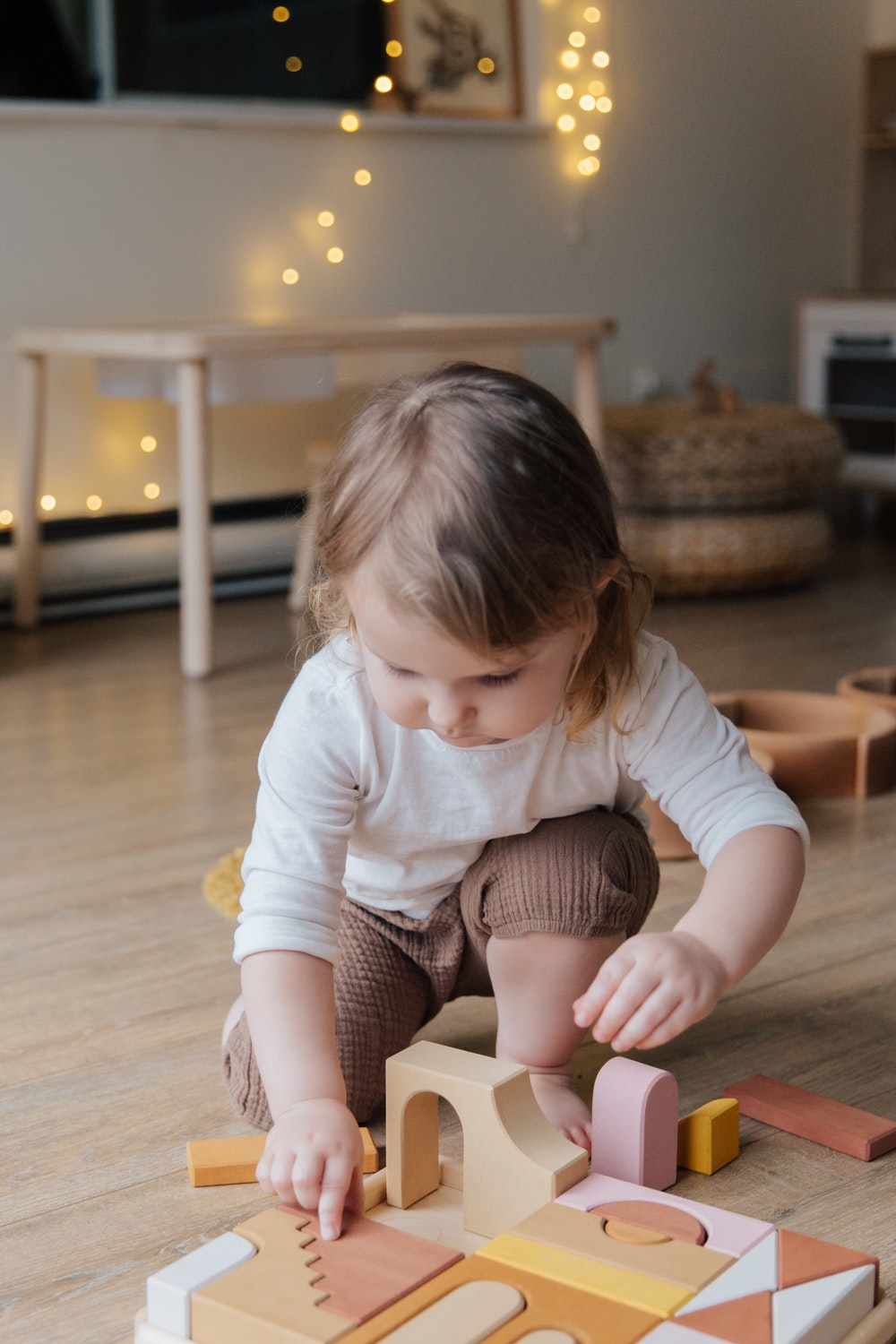
Between 12 and 24 months, children are in a sensitive period for movement, for language, and for small objects simultaneously. They move constantly, absorb vocabulary at a remarkable rate, and are fascinated by anything small enough to pick up, move, and put somewhere else. Good Montessori activities at this age work with all three of these drives at once.
Transferring activities
Transferring, moving objects or liquids from one container to another, is one of the most developmentally rich activities you can offer a toddler. It develops the pincer grip, hand-eye coordination, concentration, and the capacity to complete a purposeful sequence from beginning to middle to end.
Progressions to try:
- Simplest: transferring large pompoms from one bowl to another by hand
- Slightly harder: using a large spoon to transfer dry chickpeas between bowls
- More complex: using tongs to move larger objects
- Liquid transferring: pouring water from a small pitcher into a cup (start with very little water and a tray underneath)
Present each new activity slowly, showing the complete movement without narrating it. Then invite the child to try. Step back. Resist the urge to correct or help unless asked.
Simple puzzle work
Knob puzzles, single-piece, large-knob puzzles with realistic images (a fish, a car, an apple), are excellent for this age. The knob develops the three-finger grip. The matching of shape to space develops spatial reasoning. The realistic image connects the activity to the real world.
Progress to multi-piece puzzles only when the single-piece work is completely mastered and no longer interesting. Pushing too soon creates frustration; offering too late produces boredom. Watch the child, they will tell you when they're ready for more.
Practical life: real tools, real work
One-year-olds are deeply interested in what adults do, and intensely motivated to participate in it. Channeling this motivation into practical life work is one of Montessori's most effective and inexpensive interventions.
- Wiping: give a damp cloth and show how to wipe a table surface. Watch them do it with complete seriousness and satisfaction.
- Watering plants: a small watering can and a plant at child height. One pour per day. This is not just practical, it builds responsibility and attention to the living world.
- Helping unload the dishwasher: specifically the unbreakable, child-safe items (plastic containers, silicone items). Carry, sort, put away.
- Sorting laundry: matching socks, sorting darks and lights. Simple matching activities with real objects from daily life.
Language activities
The language sensitive period is at full intensity between 12 and 24 months. The rate of vocabulary acquisition is extraordinary. The Montessori approach is not to drill or quiz, but to name things correctly and precisely in context.
- Object baskets: a small basket with 3–5 real miniature objects (a real small apple, a real small cup, a small wooden animal). Name each object clearly when the child shows interest. No testing, just naming.
- Picture matching: a simple set of cards with realistic photographs matched to real objects
- Books: board books with photographs of real objects. At this age, realistic is better than cartoon. The child's brain is mapping words to reality, not to representations of representations.
Gross motor: purposeful movement
Toddlers need to move. The Montessori approach is not to contain this movement but to give it purpose: carrying things from one place to another, pushing and pulling carts, climbing low structures, or simply walking on a defined path (a line taped to the floor, walked with concentration and balance).
Line walking, following a line on the floor, eventually while carrying an object like a cup of water or a bell, is a classic Montessori gross motor activity that combines balance, concentration, and purposeful movement in a simple, endlessly repeatable format.