
The most important principle for Montessori activities in the first year is restraint. Not restraint of the baby, restraint of the adult. Your job is not to stimulate, entertain, or accelerate. It is to provide a safe, rich environment and then get out of the way. The baby's inner drive will do the rest.
Birth to 2 months: the visual world
Newborns see in high contrast. Their visual system is not fully developed, and colors are largely indistinguishable for the first weeks. The Montessori response to this developmental reality is the Munari mobile: a classic geometric mobile of black, white, and occasionally red shapes that hang above the baby's mat at an optimal visual distance (approximately 20–30 cm).
The Munari is not just a mobile. It moves with air currents, creating unpredictable, gentle motion that teaches cause-and-effect in the most minimal possible way: when the baby moves, the mobile moves. This is the beginning of agency, the infant's dawning understanding that their actions have effects on the world.
What you actually need to do: hang an appropriately positioned mobile, lay your baby on a firm, flat surface where they can see it, and observe. That is the activity.
2–4 months: color and visual tracking
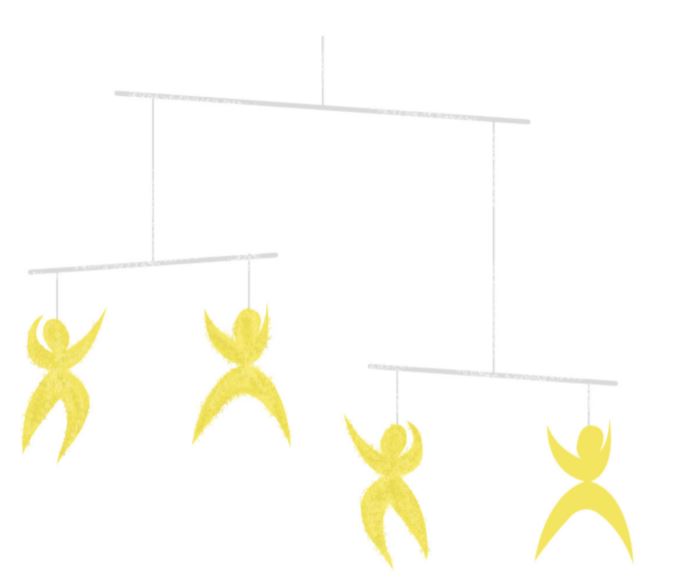
As the visual system matures, the Octahedron mobile: three geometric solids in primary colors that catch light beautifully, becomes appropriate. Followed shortly by the Gobbi mobile: five spheres in graduated shades of a single color, teaching color discrimination, and eventually the Dancers: three-dimensional figures in shiny material that reflect light and create complex, interesting movement.
During this period, supervised tummy time on the floor mat is increasingly important. It is hard work, the neck and shoulder muscles needed to lift the head are developing, and the baby will tire quickly. Short, frequent sessions on a firm surface give those muscles the exercise they need without overwhelming the baby.
4–6 months: reaching and grasping
When the baby begins to reach deliberately, usually around 4 months, the environment shifts. Now objects that can be grasped become important. Montessori uses a specific sequence of grasping materials:
- The grasping ring: a simple wooden ring that fits easily in small hands, with a smooth texture and appropriate weight
- The interlocking discs: two discs of contrasting natural materials (wood and metal) connected in a way that moves and changes when handled
- The bell cylinder: a wooden cylinder with a bell inside, teaching cause-and-effect through sound
The key principle: one object at a time, placed within reach on the mat. Not a basket of toys, one thing, deliberately chosen, positioned so the baby has to extend slightly to reach it. The reaching is the activity.
6–9 months: object permanence
Around six months, babies begin to develop object permanence, the understanding that things continue to exist when they can't be seen. This is the cognitive foundation for everything that follows (including, eventually, the understanding that you continue to exist when you leave the room, which is why separation anxiety typically emerges at this stage).
Montessori activities for object permanence:
- The object permanence box: a wooden box with a hole in the top. A ball is dropped in, disappears, and rolls out through a side opening. Simple, clean, compelling. The baby discovers that the ball continues to exist even when it can't be seen.
- Simple peek-a-boo: using a cloth, your hands, or a pillow to cover your face and then reveal it. Classic for a reason.
9–12 months: mobility and exploration
As crawling, pulling to stand, and eventually cruising develop, the baby's world expands dramatically. The Montessori environment for this stage is designed to support, not contain, this mobility. A safe floor space large enough to crawl freely, low furniture to pull up on, objects to push and pull, and activities that invite fine motor practice.
- Stacking cups or rings: simple, but powerful for developing understanding of size relationships
- Simple containers and objects: putting objects in and taking them out is endlessly satisfying at this age, and develops the pincer grip that will later be needed for writing
- Simple board books: not to read, but to handle, turn pages, and look at high-contrast images
The first year asks very little from parents in terms of materials or activities. It asks a great deal in terms of presence, observation, and the discipline not to over-intervene. Babies who spend their first year with freedom to move, interesting things to look at and grasp, and adults who interact with them calmly and attentively are building exactly what they need, with no special curriculum required.